
developed for teachers by
The Pedagogical Section Council of North America
Introduction: How and why did the Core Principles come into being?
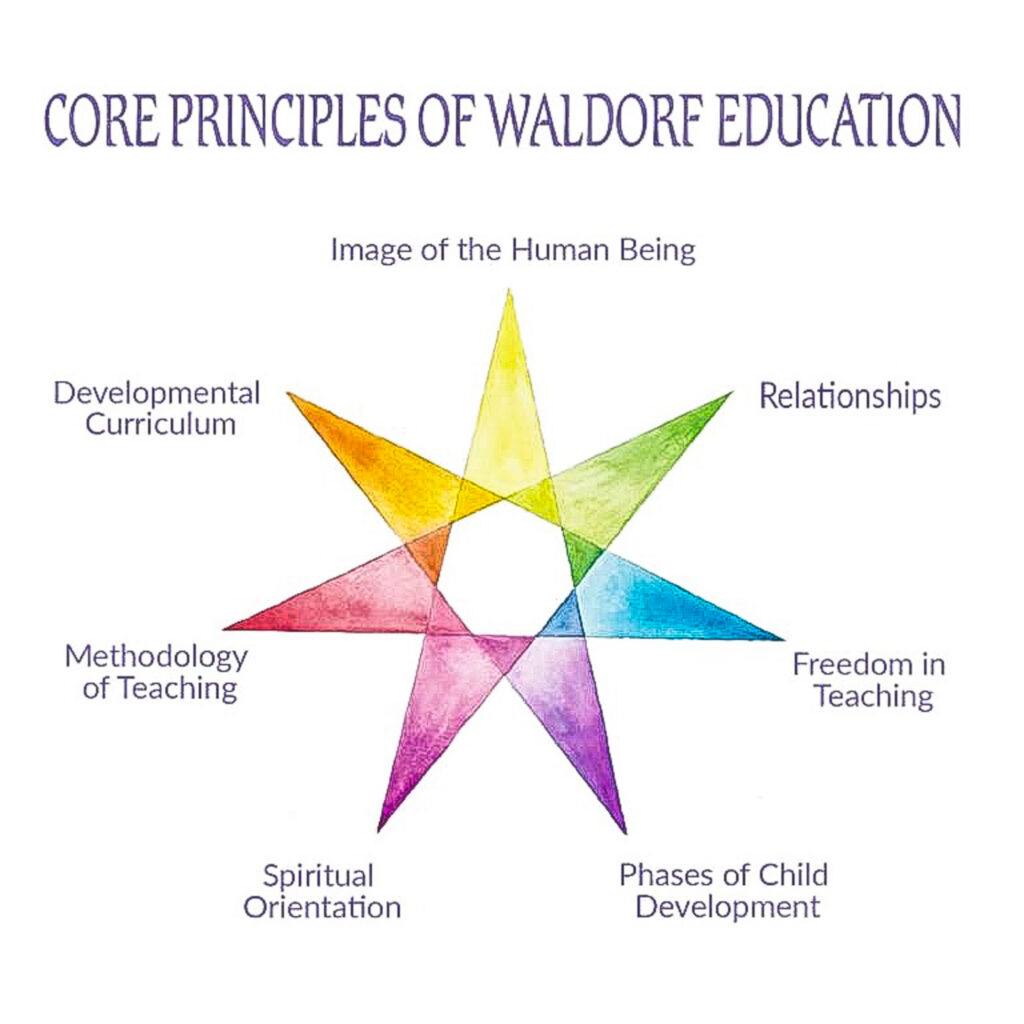
Principle 1: Image of the Human Being
The human being in its essence is a being of Spirit, soul, and body. Childhood and adolescence, from birth to twenty-one, are the periods during which the Spirit/soul gradually takes hold of the physical instrument that is our body. The Self is the irreducible spiritual individuality within each one of us, which continues its human journey through successive incarnations.
Principle 2: Phases of Child Development
This process of embodiment has an archetypal sequence of approximately seven-year phases, and each child’s development is an individual expression of the archetype. Each phase has unique and characteristic physical, emotional and cognitive dimensions.
Principle 3: Developmental Curriculum
The curriculum is created to meet and support the phase of development of the individual and the class. From birth to age 7 the guiding principle is that of imitation; from 7 to 14 the guiding principle is that of following the teacher’s guidance; during the high school years the guiding principle is idealism and the development of independent judgment.
Principle 4: Freedom in Teaching
Rudolf Steiner gave curriculum indications with the expectation that “the teacher should invent the curriculum at every moment.” Out of the understanding of child development and Waldorf pedagogy, the Waldorf teacher is expected to meet the needs of the children in the class out of his/her insights and the circumstances of the school. Interferences with the freedom of the teacher by the school, parents, standardized testing regimen, or the government, while it may be necessary in a specific circumstance (for safety or legal reasons, for example), is nonetheless a compromise.
Principle 5: Methodology of Teaching
There are a few key methodological guidelines for the grade school and high school teachers (Early Childhood teachers work with these principles appropriate to the way in which the child before the age of seven learns, out of imitation rather than direct instruction):
~Artistic metamorphosis:
_______________
A note about school governance: while not directly a pedagogical matter, school governance can be an essential aspect of freedom in teaching. Just as a developmental curriculum should support the phases of child development, school governance should support the teachers’ pedagogical freedom (while maintaining the school’s responsibilities towards society).
the teacher should understand, internalize, and then present the topic in an artistic form.
~From experience to concept:
the direction of instruction in the grade school should proceed from the students’ soul activities of willing, through feeling to thinking, while in the high school the direction is reversed.
~Holistic process:
proceeding from the whole to the parts and back again, and addressing the whole human being.
~Use of rhythm and repetition.
Principle 6: Relationships
The task of the teacher is to work with the developing individuality of each student and with the class as a whole. Healthy working relationships with parents and colleagues are also essential to the wellbeing of the class community and the school.
Principle 7: Spiritual Orientation:
In order to cultivate the imaginations, inspirations, and intuitions needed for their work, Rudolf Steiner gave the teachers an abundance of guidance for developing an inner, meditative life. This guidance includes individual professional meditations and an imagination of the circle of teachers forming an organ of spiritual perception. Faculty and individual study, artistic activity, and research form additional facets of ongoing professional development.
_______
2 The term “artistic” does not necessarily mean the traditional arts (singing, drawing, sculpting, etc.), but rather that, like those arts, the perceptually manifest reveals something invisible through utilizing perceptible media. Thus a math problem or science project can be just as artistic as storytelling or painting.
3 This mirrors the development of human cognition, which is at first active in the limbs and only later in the head.
4 There are four basic rhythms with which the Waldorf teacher works. The most basic of those is the day-night (or two-day) rhythm. Material that is presented on a given day is allowed to “go to sleep” before it is reviewed and brought to conceptual clarity on the following day. A second rhythm is that of the week. It is “the interest rhythm” and teachers strive to complete an engagement with a topic within a week of working on it. A paper that is returned to the student after more than a week will no longer be interesting to the student. The only interesting thing will be the teacher’s comments, but the topic itself is already past the “interest window.” A third rhythm is that of four weeks. A block, or unit of instruction, is usually best covered in four-week periods. This life-rhythm can be understood in contemplation of feminine reproductive cycles, for example, and can be said to bring a topic to a temporary level of maturity. The last of the pedagogical rhythms is that of a year. This is the time it can take for a new concept to be mastered to the degree that it can be used as a capacity. Thus a mathematical concept introduced early in third grade should be mastered sufficiently to be assumed as a capacity for work at the beginning of fourth grade.
– 2014 Pedagogical Section Council of N. America